
 Willem Veldhuyzen
 No Comments
 Oct 13, 2026
*Updated 10-14-2026
The IRS may still be trying to collect after 10 years because the collection period runs from the assessment date, not the year a return was originally due.
That deadline is called the Collection Statute Expiration Date, or CSED, and late filing, audits, or a Substitute for Return can push assessment years past the original tax year.
A lot of taxpayers assume old tax debt expires 10 years after the return was due.
Confusion around IRS trying to collect after 10 years usually comes from one missing detail: the clock follows assessment, not the filing season you remember.
This guide explains the collection statute expiration date, why back taxes due can stay collectible longer than expected, and how to verify the timeline with IRS records.
Key Takeaways
- The IRS can continue collecting after 10 years due to the Collection Statute Expiration Date (CSED) starting from the assessment date, not the tax due date.
- Late filings, audits, or a Substitute for Return can extend the CSED beyond the initial 10 years.
- Taxpayers often misunderstand the 10-year rule, thinking it begins when the tax return was due, but it actually hinges on the assessment date.
- Events like bankruptcy, Offer in Compromise, or Collection Due Process hearings can pause the collection period, extending it further.
- To verify timelines and collection eligibility, taxpayers should check IRS transcripts for assessment dates and tolling events.
Table of Contents
- Understand the IRS 10-Year Collection Rule (What It Is and What It Isn’t)
- Why the IRS May Still Be Collecting After “10 Years”
- How to Find Your CSED (And Confirm It’s the Right One)
- Step-by-Step: What to Do When the IRS Is Collecting Near (or Past) 10 Years
- Examples That Explain “After 10 Years” in Plain English
- Common Mistakes That Make the Situation Worse
- Practical Plan & Checklist
- Frequently Asked Questions
Understand the IRS 10-Year Collection Rule (What It Is and What It Isn’t)
The IRS generally gets a 10-year collection period to collect assessed federal tax debt, but that statute of limitations does not start when you earned the income or even when you filed on time.
It starts when the tax is assessed, which is why a taxpayer can feel blindsided by a collection notice on an old year that still has time left on the clock.
The key deadline is the Collection Statute Expiration Date, or CSED.
The Internal Revenue Code lets the IRS keep collecting tax, penalties, and interest until that date runs, so a balance can remain legally active long after the original due date has faded from memory.
This is where many mistakes happen.
A suspension of the collection period can pause the clock, and certain actions that seem helpful, such as an installment agreement request or appeal rights tied to a notice, can affect timing in ways taxpayers do not expect.
IRS Publication 1 matters here because it outlines taxpayer rights, including the right to appeal and the right to be informed.
That matters because the 10-year rule is not a rumor or an automatic wipeout; it is a date-driven collection limit that must be calculated correctly.
What Starts the 10-Year Clock: The Assessment Date
A tax assessment is the IRS’s formal recording of the liability on its books.
That usually happens after a filed return is processed, but it can also happen later after an audit, a Substitute for Return, or another IRS determination.
Late filing changes the timeline.
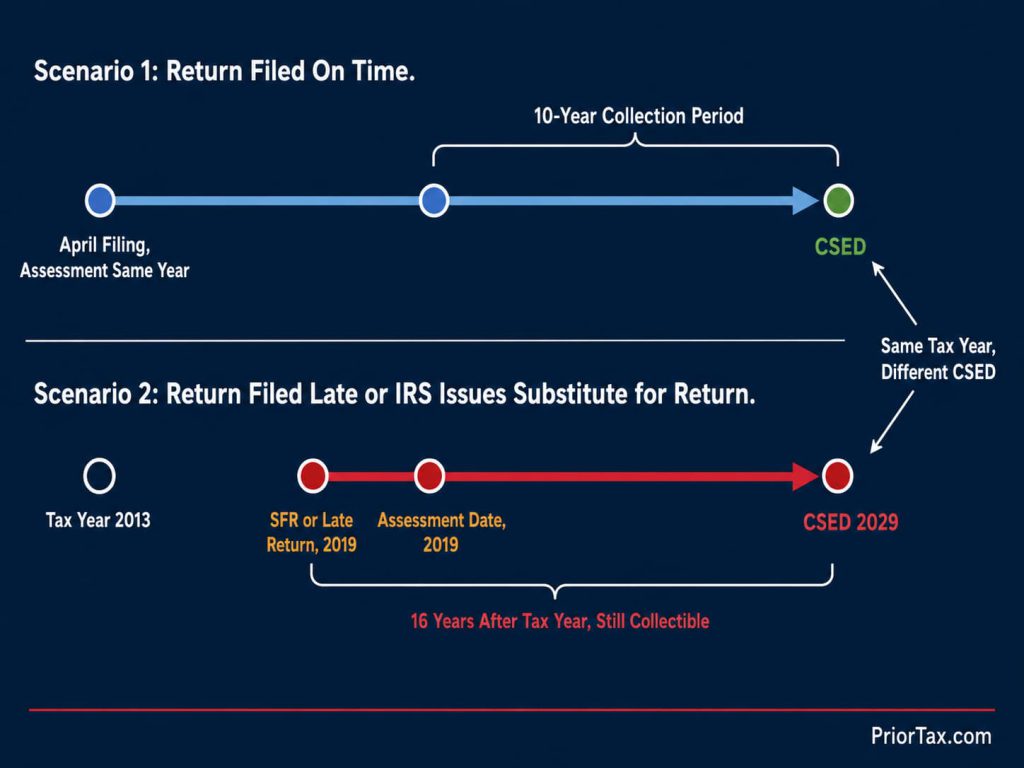
If a return was filed years after the original due date, the assessment may also land years later, which pushes the CSED later and can leave a payment plan or other collection option on the table much longer than expected.
What the IRS Can Do Before the CSED Ends
Before the CSED expires, the IRS can file a federal tax lien, issue a levy, garnish wages, and offset future refunds.
Wage garnishment is especially disruptive because it reaches current income, which turns an old tax problem into a present cash-flow problem.
Quiet periods do not mean the debt stopped growing.
Interest generally compounds daily, so a balance can increase even when no one from the IRS has contacted you for months.
Why the IRS May Still Be Collecting After “10 Years”
Most cases that look like collection after 10 years are really timing problems, not rule-breaking by the IRS.
The usual cause is that the CSED was paused by a legal event, or that the assessment happened much later than the taxpayer assumed.
Mixed tax years also create confusion.
One year may be past its CSED while another year remains collectible, which makes the IRS seem late when it is only pursuing the still-open periods.
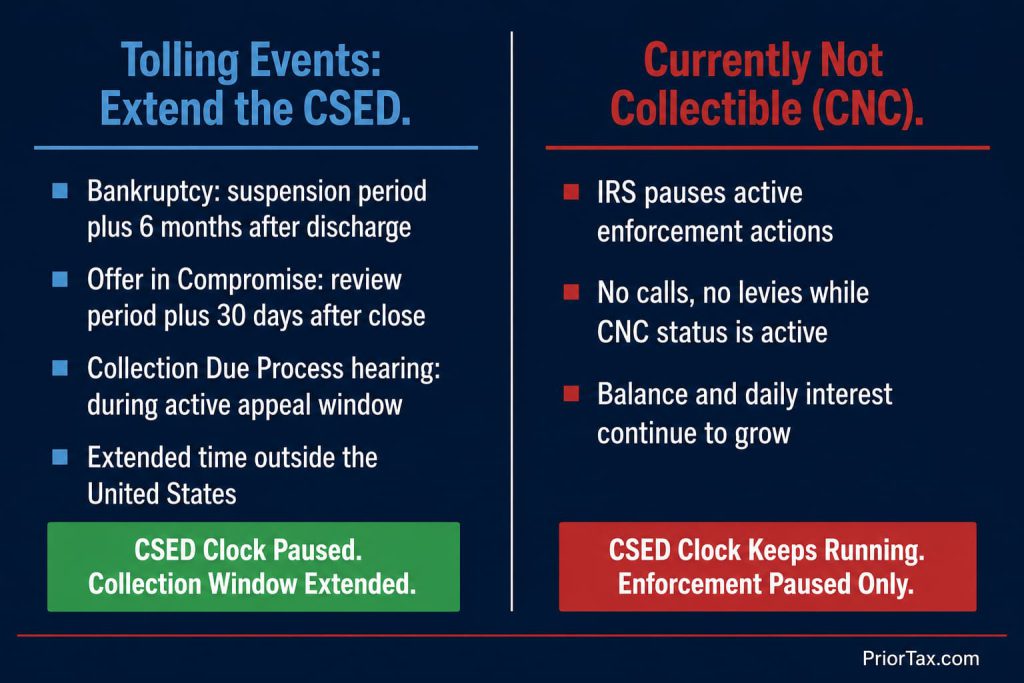
Status codes matter too. A taxpayer placed in Currently Not Collectible status may stop active enforcement for a period, but the debt does not disappear, and the CSED keeps controlling the real end point unless another tolling event intervenes.
Guessing is expensive.
If the dates feel wrong, verify the IRS computation instead of arguing from memory, because transcript dates usually resolve whether the problem is tolling, late assessment, or a simple misunderstanding.
Common Events That Suspend (Toll) the Collection Period
Bankruptcy can suspend IRS collection while the case is pending and for additional time after the case ends.
That means a taxpayer can count 10 calendar years and still be short of the true expiration date.
An Offer in Compromise, often shortened to OIC, can also pause the clock while the offer is under review and for certain follow-up periods.
Collection due process hearings do the same during the appeal window, which is why procedural rights can change the collection timeline.
Living outside the United States for an extended period may suspend collection under certain rules.
That detail matters for expatriates and long-term overseas workers because physical absence can affect federal collection dates even when the tax year itself is old.
Assessment Happened Later Than You Think
If no return was filed, the IRS may prepare a Substitute for Return years later.
That creates an assessment on the IRS timeline, not on the taxpayer’s memory of the original deadline.
Audits can create added assessments too.
A 2015 tax return adjusted in 2021 can produce a newer assessment with its own collection life, which is why one tax year can contain more than one date that matters.
How to Find Your CSED (And Confirm It’s the Right One)
Account transcripts are the fastest practical way to reconstruct the collection timeline for each tax period.
They show when the IRS posted assessments and later collection actions, which makes them central to the taxpayer’s Right to Finality under the Taxpayer Bill of Rights.
Use the right transcript for the right liability.
A Form 1040 income tax debt, a payroll tax issue, and a trust fund recovery penalty can each follow different records, so mixing forms or years produces bad CSED estimates.
Track each year separately in a simple table. List the tax year, assessment date, known tolling events, and your estimated CSED, because a year-by-year worksheet turns a vague dispute into a date problem that can be checked.
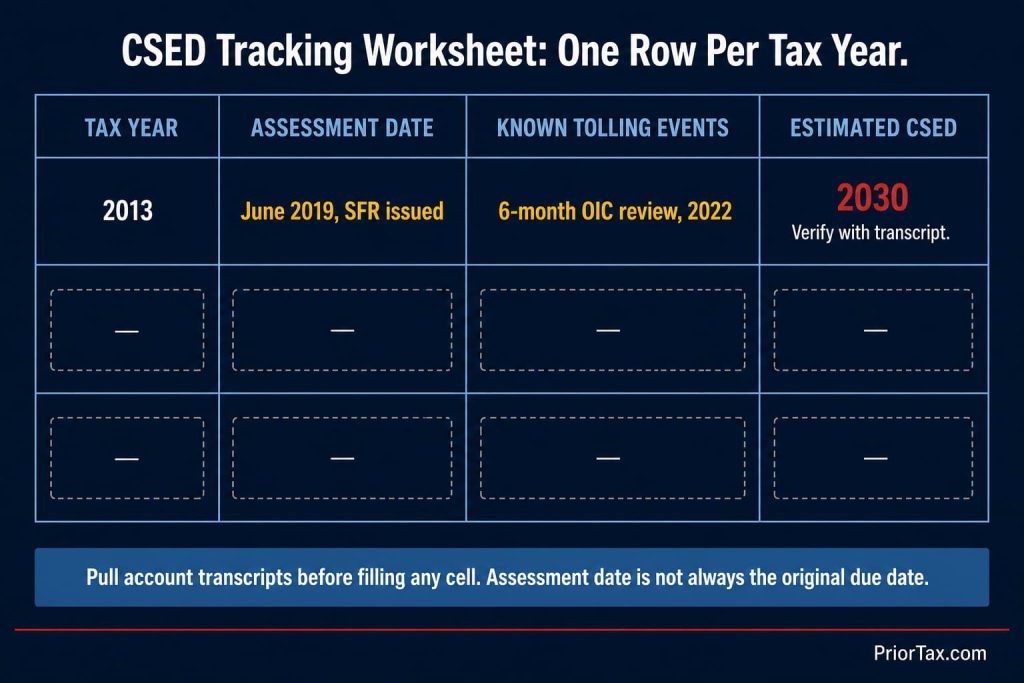
If a notice does not line up with your transcript timeline, treat that as a verification issue.
The strongest position with the IRS is usually a documented chronology, not a broad claim that the debt feels too old.
Where the CSED Shows Up on an IRS Account Transcript
The CSED is not always printed plainly, but the transactions section gives the pieces needed to estimate it.
Look for assessment-related entries, later reversals or adjustments, and collection markers that help identify what happened and when.
Context matters as much as the code list.
A transcript can often show whether the balance came from your filed return, an audit change, or an SFR, and that distinction tells you why the collection window looks longer than expected.
What to Do If You Think the IRS Calculated the CSED Wrong
Start with dates and documents, not conclusions.
Ask the Internal Revenue Service to explain the assessment date and each tolling event you believe affected the account, then compare that explanation against your transcript record.
If the file stalls, escalate carefully through normal IRS channels.
The Taxpayer Bill of Rights gives you the right to challenge the IRS’s position and be heard, which is most useful when your timeline is organized and specific.
Step-by-Step: What to Do When the IRS Is Collecting Near (or Past) 10 Years
First, get compliant.
Filing missing returns protects more resolution options and prevents the IRS from relying on SFR figures that often overstate the balance.
Second, pull transcripts and build a timeline for each year. Match notices to tax periods, then compare the notice dates against the assessment date, any suspension periods, and the likely CSED.
Third, choose a resolution path that fits both cash flow and timing.
A short remaining collection window may call for a different strategy than a debt with years left, and the wrong move can stretch a problem you might otherwise outlast.
If You Haven’t Filed: File First, Even If You Can’t Pay
The failure-to-file penalty is usually steeper than the failure-to-pay penalty, which is why filing even without payment often limits damage. A correct return can also replace an inflated SFR by claiming deductions and credits the IRS did not include.
Penalty abatement may help in some cases, but it works better after the filing gap is closed. PriorTax’s long focus on prior-year returns reflects a practical truth: compliance usually comes before collection strategy, not after.
See PriorTax’s guidance on filing back taxes and a missed deadline for your taxes for the filing side of the problem.
If You’re Facing Active Enforcement
A lien is a legal claim against property.
A levy is the immediate seizure tool, and that distinction matters because levy risk often demands faster action than a filed notice of federal tax lien.
Eligible taxpayers should review whether a Collection Due Process hearing is available. A timely CDP request can pause collection and preserve appeal rights, which can be critical when the account is close to its collection deadline.
Examples That Explain “After 10 Years” in Plain English
Example one: the tax year is old, but the assessment is newer.
A 2013 return filed in 2019 may lead to a CSED tied to 2019 tax year, not 2014, so collection in 2026 is not unusual.
Example two: the clock was paused. Bankruptcy, an OIC, or a CDP hearing can suspend collection time, which means 10 calendar years on the wall may represent only eight or nine years of actual collection time.
Example three: multiple years create mixed signals.
The IRS may stop collecting 2012 but still pursue 2015 and 2017, making it look like the entire account should be expired when only one period is.
Mini Case Study: Substitute for Return Creates a Longer Timeline Feel
An SFR often makes the debt feel older than it is because the original due date and the assessment date are far apart.
If the IRS files an SFR years later, the collection clock starts from that later assessment, not from the year the taxpayer missed.
The taxpayer can still file an accurate return to reduce the balance.
That step may change the amount owed, but the collection window still follows the assessment timeline unless a later adjustment creates a new assessed amount.
Common Mistakes That Make the Situation Worse
The biggest mistake is assuming the 10-year rule starts when the return was due.
The IRS 10-year statute for collection generally runs from assessment, and that single error causes taxpayers to ignore notices they should be checking closely.
Another bad move is waiting for enforced collection.
Early responses preserve more options, while silence invites liens, levies, and refund offsets that are harder to unwind once they start.
State tax debt adds another trap.
Federal and state agencies use different rules, so a state collection case may remain active even if the federal period is near expiration.
Mistake: Letting an SFR Stand
SFR assessments often exclude deductions, credits, and filing status details that reduce tax.
Leaving that return in place can inflate the debt and distort every later decision about settlement, payment, or waiting out the CSED.
Mistake: Making Decisions Without Checking Transcripts
No transcript, no timeline.
Without assessment dates and tolling periods, taxpayers end up relying on myths instead of records.
If you want a plain-language overview of the rule itself, PriorTax’s article on the IRS 10-year statute is useful background.
Practical Plan & Checklist
The IRS 10-year rule is about the CSED, not the tax year on the notice.
Tolling events, late assessments, and multiple periods explain most cases where collection seems to continue past 10 years.
Transcripts give the clearest path to answers.
Filing missing returns can reduce inflated balances, especially where an SFR drove the assessment, and that often changes both the amount owed and the best next step.
Checklist: What to Gather Before You Call the IRS
Gather IRS notices, the tax years involved, and any certified mail records.
Pull account transcripts for each year and note bankruptcy dates, OIC filings, CDP requests, appeals, and time spent outside the United States if relevant.
Where PriorTax Experience Fits (Non-Commercial Context)
PriorTax’s experience with prior-year filing highlights the first move many taxpayers miss: get the returns filed before arguing over collection.
Accurate filing can reduce an SFR-based balance and make the CSED analysis cleaner because the account history becomes easier to read.
Frequently Asked Questions
Why is the IRS still trying to collect after 10 years?
The IRS usually gets 10 years from the assessment date, not the original due date. Bankruptcy, an Offer in Compromise, or a Collection Due Process hearing can suspend the CSED and extend the collection window.
Can IRS debt be forgiven after 10 years?
Not automatically. Collection usually ends when the CSED expires, but the IRS can still collect if the period was paused or the assessment happened later than you thought.
How many years can the IRS go back to collect unpaid taxes?
For collection, the IRS generally has 10 years from the assessment date for each tax period. The real timeline can last longer if the collection statute was suspended.
What happens if you don’t pay the IRS for 10 years?
Before the CSED ends, the IRS can use liens, levies, refund offsets, and wage garnishment, while interest and penalties keep growing. If the CSED expires without tolling, the IRS must stop collecting that assessed balance.
Old tax debt rarely turns on one dramatic event. It turns on dates, assessments, transcript entries, and whether the collection clock ever stopped running.

About The Author
Willem Veldhuyzen is the founder and president of PriorTax and an IRS-enrolled professional. PriorTax has been in business for 20 years since 2006, and he’s hands-on with tax calculations, software updates, and customer support.

Categories: