
 Willem Veldhuyzen
 No Comments
 Oct 20, 2026
*Updated 10-14-2026
Florida has no state personal income tax, so back taxes in Florida almost always point to unfiled or unpaid federal returns rather than a state filing problem.
Filing every missing year matters more than waiting until you can pay in full, since unfiled returns risk an IRS-prepared substitute return that leaves out deductions, credits, and dependents you’re entitled to claim.
Missed tax years usually start with one skipped deadline and end with a stack of notices, missing forms, and uncertainty about what you owe.
If you need to file back taxes in Florida, the first thing to know is that filing the missing returns matters more than waiting until you can pay everything.
Key Takeaways
- Florida has no state personal income tax, so back taxes usually involve federal tax issues rather than state filings.
- Filing missing tax returns is critical because it prevents IRS-substituted returns that ignore deductions and credits you deserve.
- To file back taxes in Florida, identify missing years, pull IRS transcripts, and prepare returns using the specific year’s rules.
- Businesses should also consider Florida Department of Revenue taxes, as they face different rules from federal tax compliance.
- Begin filing as soon as possible to limit penalties and maintain future filing compliance, especially regarding federal taxes.
Table of Contents
- What “Back Taxes” Means in Florida (Federal vs. State)
- Common Florida Scenarios That Create Back Taxes
- Why Filing Matters Even If You Don’t Owe
- Start With a Quick Assessment: Which Years Are Missing and What’s at Stake
- How Many Years Back You May Need to File
- Gather Your Documents: IRS Transcripts and Missing Income Records
- Reconstructing Self-Employment Income and Expenses
- Prepare Prior-Year Returns Correctly (Each Year Uses Its Own Rules)
- File First, Then Handle Payment: Penalties, Interest, and Relief Options
- Florida-Specific Considerations: Department of Revenue Collections and Business Taxes
- Example Walkthrough: Catching Up on Three Years of Unfiled Returns
- Checklist You Can Reuse for Each Missing Year
- Common Mistakes to Avoid When Filing Back Taxes
- Next Steps to Take
- Frequently Asked Questions
This guide explains what counts as back taxes in Florida, how to identify missing years, which records to pull, and how to deal with payment, penalties, and Florida-specific business tax issues before a levy or deeper collection action develops.
What “Back Taxes” Means in Florida (Federal vs. State)
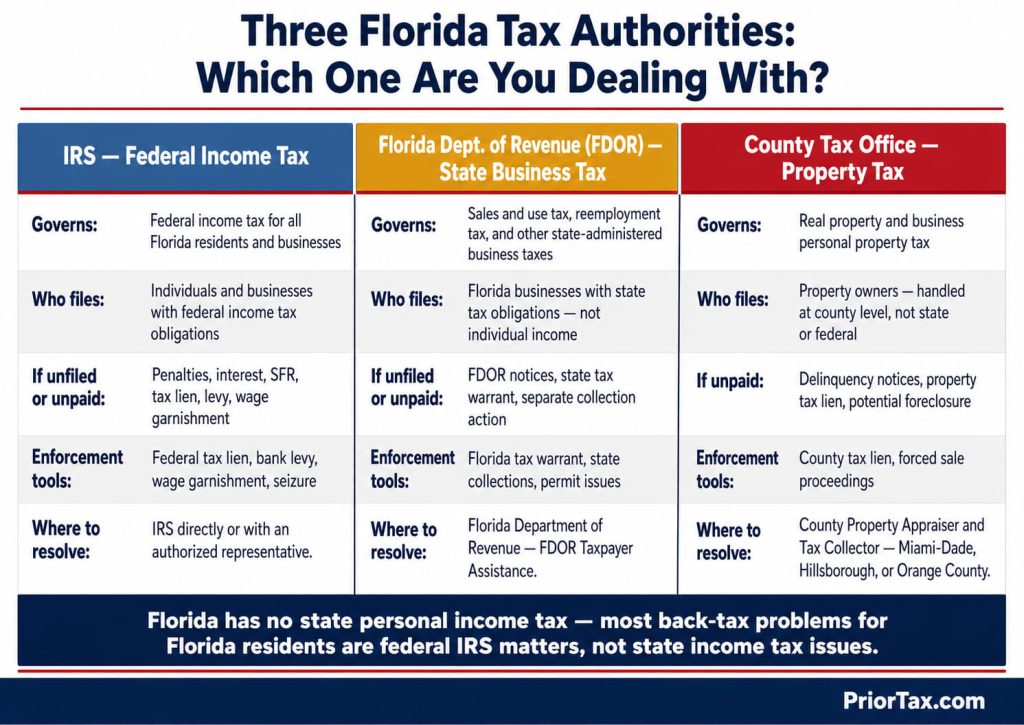
For most Florida residents, whether you live in Miami, Tampa, Orlando, Jacksonville, Fort Lauderdale, or St. Petersburg, back taxes mean federal income tax problems, not state personal income tax problems, because there is no Florida state income tax.
That single fact changes the process: many people who talk about past due tax returns in Florida are really dealing with the IRS, while business owners may also face Florida Department of Revenue issues.
Florida back-tax cases often split into two buckets: unfiled tax returns and unpaid balances. You can have unfiled tax returns with no amount due, or a filed return with a balance still unpaid, and the fix is different in each case.
Businesses add another layer because Florida administers taxes such as sales and use tax, which can create state-level filing and collection problems separate from federal income tax.
E-file options may be available for some years and tax types, but eligibility depends on the year and the return involved, so method matters less than getting accurate filings submitted.
Common Florida Scenarios That Create Back Taxes
A W-2 employee may miss one or more filing years and still be owed a refund, especially if withholding was high, since the IRS notes that more than 70% of tax returns processed recently received a refund. Poor recordkeeping turns a simple catch-up filing into a reconstruction project.
Self-employed workers, freelancers, and gig drivers often fall behind after missing 1099 income, quarterly estimates, or deductible expense tracking.
This is common among Orlando hospitality and theme-park contractors, Miami rideshare and gig work, and Tampa Bay independent contractors who set bookkeeping aside during a busy season.
Small businesses may also miss sales tax or payroll tax filings, which can trigger both federal and Florida notices.
Why Filing Matters Even If You Don’t Owe
Refunds and credits are not automatic.
The IRS refund claim statute of limitations is generally 3 years from the date you filed your return or 2 years from the date you paid the tax, whichever is later, and waiting too long can mean losing money that would otherwise come back to you.
Unfiled returns also increase the risk of an IRS substitute return based only on income documents it received. That usually means deductions, dependents, and credits are left out, which can inflate the bill.
Nonfiling is almost always treated as a civil matter, and criminal prosecution is rare and generally reserved for deliberate evasion, but remaining unfiled keeps that risk open longer than it needs to be.
Start With a Quick Assessment: Which Years Are Missing and What’s at Stake
Write down every year you think was missed, then estimate whether each one looks like a refund year, a break-even year, or a balance-due year.
That rough map helps you focus first on years where money may be recoverable and where delay could close the refund claim window.
Urgency rises fast when notices mention the tax collection process, a tax lien, a wage levy, wage garnishment, or a bank levy.
Collection pressure changes the timeline because once enforcement starts, filing becomes both a compliance step and a defense against inflated or incomplete IRS assessments.
Facts drive outcomes here. Large balances, business issues, or active enforcement often justify review by an enrolled agent, CPA, or tax attorney.
How Many Years Back You May Need to File
No single rule fits every taxpayer because filing requirements depend on income, filing status, and what the IRS already has on record.
An account transcript and tax transcript often show whether the IRS assessed a balance, posted a substitute return, or still lists a year as missing.
In many compliance cases, the IRS may focus on a group of recent years, but notices and transcript data should guide the decision. Guessing wrong can leave an older problem open while you solve a newer one.
Gather Your Documents: IRS Transcripts and Missing Income Records
Start with your IRS online account because it gives you a direct view of filed years, balances, and available records. The most useful rebuild tool is the Wage & Income transcript, which shows W-2s, 1099s, and other income forms reported to the IRS for each year.
Self-employment cases need more than income forms. Bank statements, receipts, mileage logs, payment processor reports, and bookkeeping exports help rebuild deductible expenses in a way that can be explained if questioned later.
Address issues create avoidable damage. If the IRS does not have your current mailing address, notices can keep moving while you remain unaware of deadlines or collection steps.
What to Pull From the IRS (And Why)
The wage & income transcript helps reconstruct reported income when original forms are missing.
The account transcript shows assessments, payments, filing history, and signs that the IRS may have prepared a substitute return.
If you expect a balance due, keep Form 9465 on your radar because it is commonly used to request an installment plan. That matters after filing, not before, but planning payment early prevents panic once the numbers are final.
Reconstructing Self-Employment Income and Expenses
Separate business from personal transactions before you total anything.
Clean categorization makes schedule C reporting more accurate and reduces the chance that unsupported deductions create a new problem.
Use a conservative method. A deduction is strongest when the amount matches records you can produce and explain without stretching assumptions.
Prepare Prior-Year Returns Correctly (Each Year Uses Its Own Rules)
Every prior-year tax return must use that specific year’s forms, rates, standard deduction, and credit rules.
Tax law changes yearly, so using current-year software logic on an older return can produce the wrong result even when the income numbers are right.
Late filing after a missed deadline is still filing, and an extension to file (Form 4868) generally gives more time to file, not more time to pay.
If you already filed but made mistakes, an amended return on Form 1040-X is usually the right tool; if you never filed at all, you normally need an original return for that year instead.
Readers dealing with late filing often discover that speed matters, but accuracy matters more. A rushed return that omits income or overclaims credits can turn one compliance problem into two.
E-Filing vs. Mailing Prior-Year Returns
Eligible prior years may be e-filed, which usually speeds processing and gives faster confirmation.
Older years often require paper filing, printed and mailed, and certified mail with return receipt creates proof of filing if processing is delayed.
People worried about filing after the deadline should treat mailing proof as part of the file. Documentation can matter if the IRS later questions when the return was sent.
If the IRS Filed a Substitute for Return (SFR)
An SFR usually relies on income documents the IRS received and leaves out many deductions and credits. Filing an accurate original return can replace that calculation in many cases, which may reduce the assessed balance.
File First, Then Handle Payment: Penalties, Interest, and Relief Options
The failure-to-file penalty and failure-to-pay penalty are separate, and the filing penalty is often harsher.
PriorTax’s late-filing knowledge base reflects common IRS penalty structure: failure to file is 5% of the unpaid tax per month (up to 25%), while failure to pay is 0.5% of the unpaid tax per month (up to 25%), with daily compounding interest continuing to accrue.
That difference explains why filing now often costs less than waiting for full payment capacity.
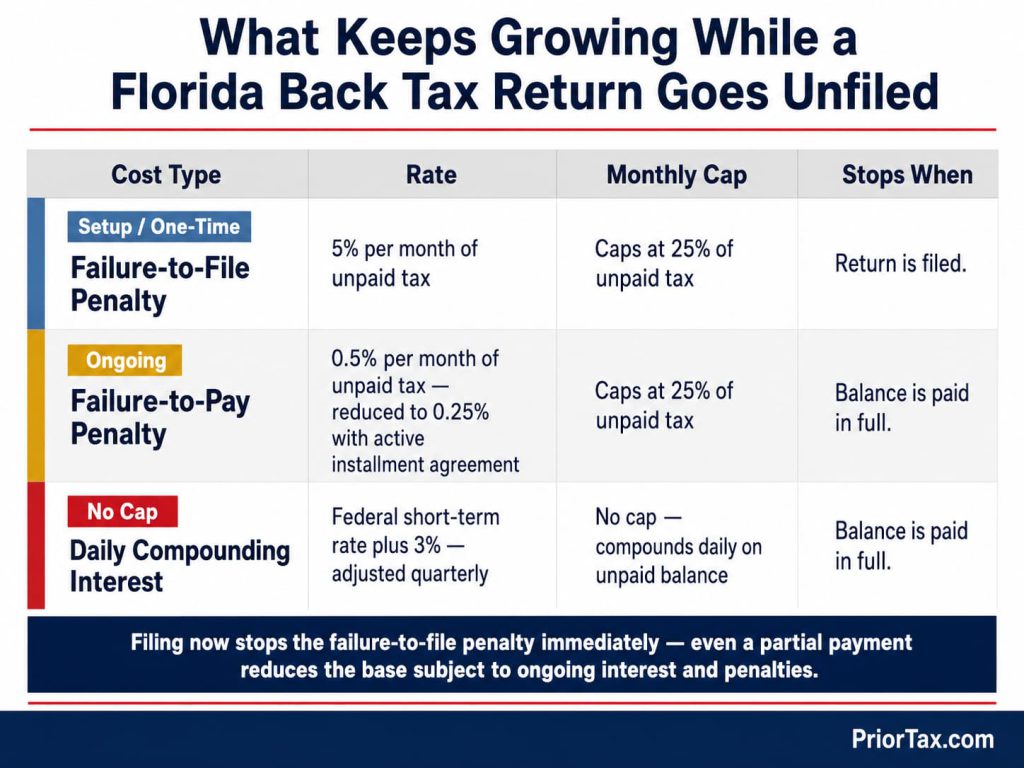
Partial payments can reduce the balance subject to ongoing interest and penalties, which turns even a modest payment into a damage-control step.
If you cannot pay in full, an installment agreement may be an option after returns are filed. Penalty relief may also be available through first-time abatement or a reasonable cause request, but approval depends on the facts and your compliance history.
Practical Ways to Reduce the Damage While Catching Up
Send a good-faith payment with the return if possible. Even a small amount can reduce future charges while showing active compliance.
Fix the forward problem too.
Updated withholding or estimated tax payments keep a resolved back-tax case from becoming a repeat case next April.
When an Offer in Compromise Might Come Up
An offer in compromise usually enters the conversation when full payment is not realistic and the taxpayer meets IRS criteria, including being current on required filings and not being in an open bankruptcy proceeding under IRS Topic no. 204 (offers in compromise).
Most people still need filing compliance first, and many begin with an installment agreement before considering settlement routes.
Florida-Specific Considerations: Department of Revenue Collections and Business Taxes
Florida residents usually deal with the IRS for personal income tax, but businesses may face the Florida Department of Revenue for state-administered taxes such as Florida sales and use tax.
That distinction matters because an IRS notice and an FDOR notice can look similar while carrying different rules, deadlines, and collection paths.
Property tax is a separate matter handled at the county level, not by the IRS or FDOR.
A Miami homeowner deals with the Miami-Dade County Property Appraiser and Tax Collector, an Orlando homeowner with the Orange County Property Appraiser, and a Tampa homeowner with the Hillsborough County Property Appraiser. Being current on federal returns does not resolve a county property tax balance, and the two follow different collection rules.
FDOR correspondence should never sit unanswered. State collection activity can escalate if delinquent returns remain unresolved, especially where trust-fund style taxes are involved.
Payment options may exist, but the first step is still compliance.
Filing missing state-administered returns gives FDOR a basis to evaluate what is owed and what arrangement, if any, may be available. FDOR Taxpayer Assistance can answer state account questions.
What a Florida Tax Warrant Generally Refers To
A tax warrant in Florida generally refers to a state collection tool tied to delinquent state-administered taxes. The exact effect depends on the tax type, notice stage, and FDOR procedure, so the document itself matters more than the label.
If You’re Registering or Reopening a Business
Check for unresolved sales tax, reemployment tax, or other filing duties before reopening operations.
Tax compliance often surfaces during licensing, financing, and contract review, so old liabilities can block new business plans.
Example Walkthrough: Catching Up on Three Years of Unfiled Returns
Assume a Florida taxpayer missed 2022, 2023, and 2024, earned both W-2 wages and 1099 income, and does not know whether any year shows a refund.
The clean sequence is to pull wage & income transcripts, gather bank and expense records, prepare each year separately, and file in year-specific form.
Suppose 2022 appears refund-eligible, 2023 shows a small balance, and 2024 has missing 1099 income.
That order tells you to protect the oldest refund year quickly, verify the missing income against transcripts, and then decide whether a payment plan is needed after all returns are processed.
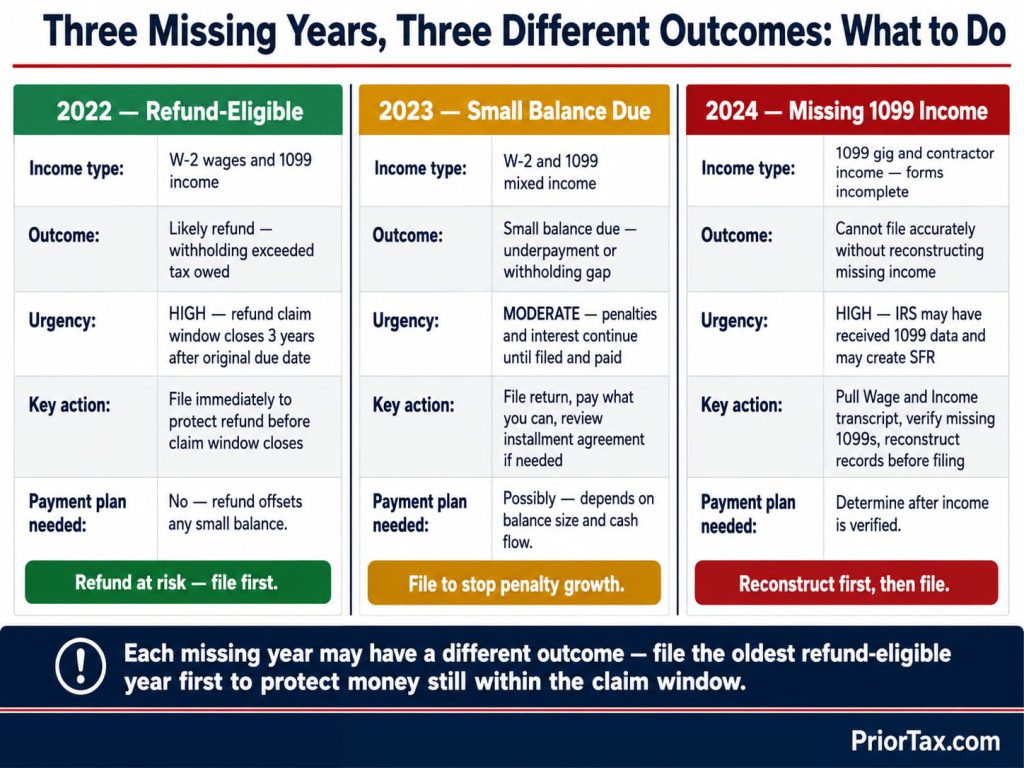
The outcome is not “problem solved overnight.”
Filing stops the unfiled-return problem from growing and creates a real number to work from instead of fear built on guesses.
Checklist You Can Reuse for Each Missing Year
- Income records confirmed through W-2s, 1099s, and transcripts
- Deductions and credits supported by receipts, statements, and eligibility rules
- Correct-year return prepared and filed through the eligible method
- Payment plan reviewed if a balance remains after filing
People asking whether they are still able to file usually need this kind of repeatable checklist more than broad tax theory.
Common Mistakes to Avoid When Filing Back Taxes
Waiting until you can pay in full is one of the most expensive mistakes because penalties and interest may keep growing while no return is on file.
Using the wrong year’s forms creates a quieter problem, but it can delay processing or produce a wrong assessment that takes more time to fix.
Notices from the IRS or FDOR should be matched to the exact tax year and tax type before you respond.
A notice about filing is different from a notice about payment, and treating them as the same can send you down the wrong path.
Another recurring mistake is failing to fix withholding or estimated payments after the old returns are filed. Catch-up work fails if the current year becomes the next delinquent year.
Documentation and Audit-Readiness Mistakes
Unsupported deductions weaken an otherwise valid return.
Mixed personal and business spending also creates credibility issues because the numbers stop telling a clear story.
Next Steps to Take
Start by confirming which years are missing, then pull transcripts and prepare each return using that year’s rules.
Filing comes first because it protects refund claims, reduces exposure to harsher penalties, and gives you a real balance to address.
If money is owed, choose a payment approach you can maintain and keep future filings current.
Florida residents usually focus on federal income tax compliance, while business owners may also need to resolve FDOR-administered taxes.
PriorTax’s experience sits squarely in this workflow because prior-year filing cases often involve missing forms, transcript reconstruction, and questions about which years can still be e-filed.
Complex matters such as business taxes, liens, levies, or multi-year nonfiling may also call for a credentialed tax professional who can review the facts of your specific case.
Frequently Asked Questions
What is a tax warrant in Florida?
A Florida tax warrant generally refers to a state collection tool related to delinquent state-administered taxes. The exact meaning depends on the tax type and notice, so confirm details with the Florida Department of Revenue or a qualified professional.
How many years can you go without filing taxes in Florida?
Florida has no state personal income tax, but federal filing rules still apply. How many unfiled years you need to file depends on your income, IRS notices, and transcript history.
Is SSDI taxable in Florida?
Florida does not tax personal income, including SSDI. SSDI may still be taxable at the federal level depending on total income and filing status.
How to fix unfiled taxes?
Identify the missing years, pull IRS transcripts, prepare the correct prior-year returns, and file them. If a balance is due, review an installment agreement or other relief options after filing.
Does filing back taxes work differently in Miami, Tampa, or Orlando?
The federal process is identical in every Florida city. You file prior-year federal returns with the IRS regardless of metro, because Florida has no state personal income tax. What changes locally is property tax, handled by your county Property Appraiser and Tax Collector, such as Miami-Dade, Hillsborough for Tampa, or Orange for Orlando, and any Florida Department of Revenue business tax tied to where you operate. Federal back taxes, county property tax, and state business tax are separate problems, and resolving one does not clear the others.

About The Author
Willem Veldhuyzen is the founder and president of PriorTax. PriorTax has been in business for 20 years since 2006, and he’s hands-on with tax calculations, software updates, and customer support.

Categories: