
 admin
admin No Comments
 Jul 9, 2026
*Updated 10/14/2026
Filing back taxes in Texas almost always means catching up on federal returns with the IRS, since Texas has no state personal income tax for individuals.
Each missing year needs its own return prepared on that year’s specific Form 1040 and schedules, because tax brackets, credits, and rules change annually and current-year forms will produce the wrong result.
Missing old tax returns creates two separate problems: unfiled paperwork and unpaid balances.
For people trying to file back taxes in Texas, the first point to understand is that Texas usually is not the income-tax problem; the IRS is.
This guide explains which returns matter, how to find missing years, what forms to use, and what happens after you file late.
Key Takeaways
- Filing back taxes in Texas typically involves unfiled federal returns since there is no state personal income tax.
- Each missing year requires its specific Form 1040 and schedules due to changing tax regulations.
- Taxpayers should first identify which years are missing and gather supporting documents to ensure accuracy.
- Filing back taxes promptly helps avoid escalating penalties, even if you cannot pay in full right away.
- Texas taxpayers must also consider separate requirements for sales tax, property tax, and franchise tax when filing.
Table of contents
- What “Back Taxes” Means in Texas (Federal vs. State)
- Before You File: Identify Which Years Are Missing and Why
- Step 1: Gather Documents (and What to Do If You’re Missing Them)
- Step 2: Use the Correct Prior-Year Forms and Software
- Step 3: File Even If You Can’t Pay in Full
- Step 4: Submit Returns Correctly and Track Processing
- If You Owe After Filing: Practical Resolution Paths
- Texas-Specific Situations to Watch
- Common Mistakes When Catching Up on Back Taxes
- FAQs
What “Back Taxes” Means in Texas (Federal vs. State)
For most individuals, “back taxes” in Texas, whether you live in Houston, San Antonio, Dallas, Austin, or El Paso, means unfiled federal returns or past due returns with the IRS, because Texas has no state personal income tax.
That distinction matters because many taxpayers search for a Texas return that does not exist, then miss the federal filing steps that control refunds, penalties, and collection activity.
Texas-related tax issues still exist outside personal income tax.
A resident or business may owe sales and use tax, franchise tax, property tax, or certain local taxes, and those are handled by Texas agencies or local offices rather than the IRS.
Filing and paying are not the same event.
You may need to file multiple years first, even if you cannot pay immediately, and free programs such as Volunteer Income Tax Assistance can help some eligible filers while software such as TurboTax may be less suited to older late-year work than platforms built around prior returns.
Common Types of Texas-Related Tax Problems
One common issue is an unfiled federal Form 1040 from years when the taxpayer lived or worked in Texas.
Another is a late business filing with the Texas Comptroller of Public Accounts for sales tax or franchise tax, which can trigger separate state notices and penalties.
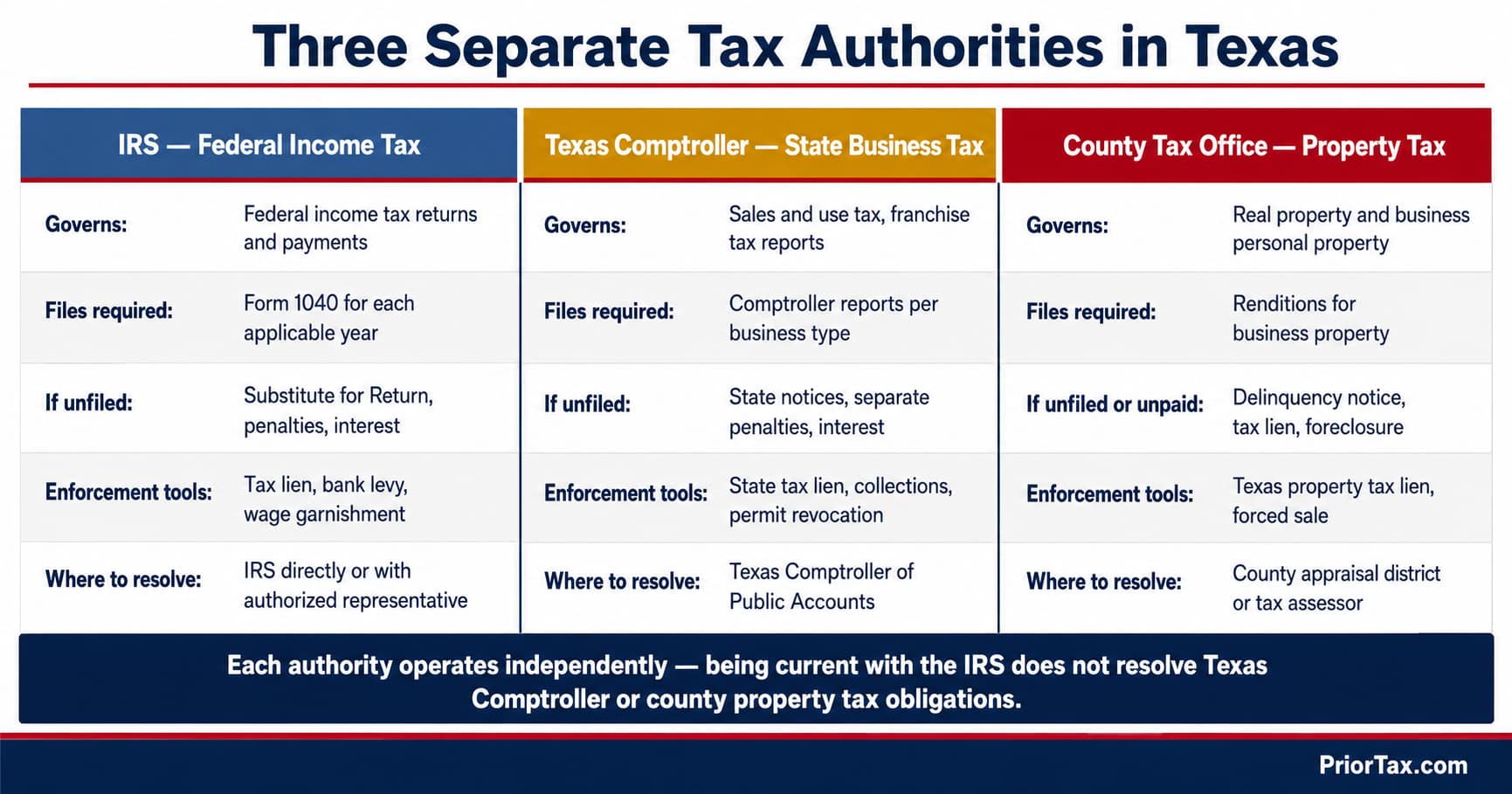
Property tax debt follows a different path.
County tax assessor-collector offices and appraisal districts handle those bills, not the IRS.
A Houston homeowner works with the Harris County Appraisal District, a Dallas homeowner with the Dallas Central Appraisal District, and a San Antonio homeowner with the Bexar Appraisal District, while PriorTax handles federal return catch-up rather than local property tax enforcement.
County tax assessor-collector offices and appraisal districts handle those bills, not the IRS, and services like PriorTax may help with federal return catch-up but not local property tax enforcement.
Before You File: Identify Which Years Are Missing and Why
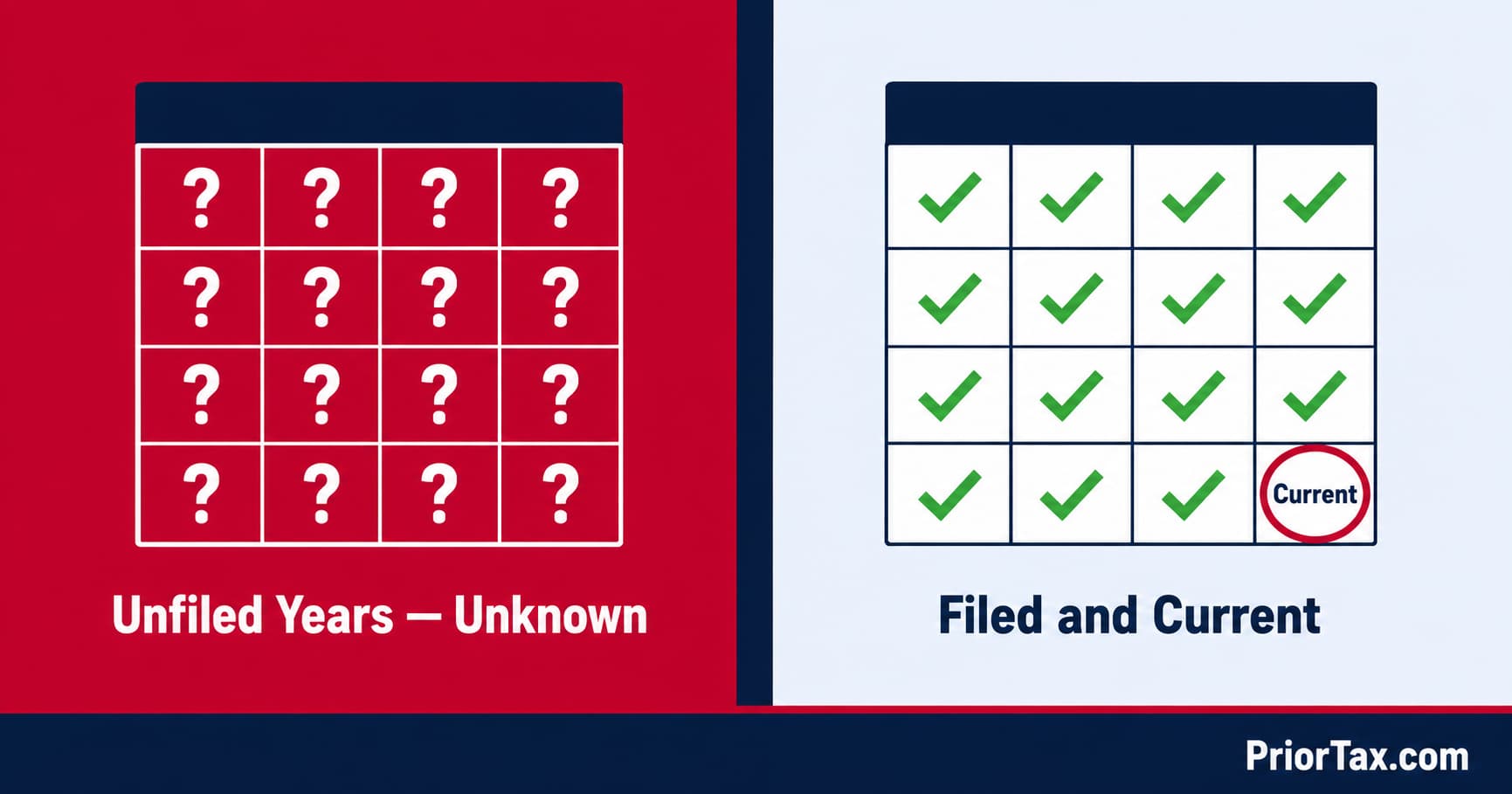
Start with a year-by-year list.
Note which returns are missing, whether you expect a refund or a balance due, and whether you received any IRS notice, because the notice history often shows which years the government is already reviewing.
Refund years deserve fast attention because of the three-year refund rule. If the original deadline passed more than three years ago, the refund is generally lost, so timing affects cash, not only compliance.
Uncertainty is common, especially after moves, divorce, or self-employment. An account transcript can confirm filing status, balances, and IRS actions, and some taxpayers use software with Expert Review to catch issues before submitting old returns.
How Far Back You Typically Need to Go
Many tax professionals try to bring a taxpayer current by filing the most recent six years. That is a practical IRS compliance benchmark in many cases, but it is not a universal rule because audits, substitute returns, and business issues can push the scope wider.
Refund claims usually must be filed within three years of the original due date. A late return filed after that window may still satisfy a filing requirement, but the refund may be gone.
Step 1: Gather Documents (and What to Do If You’re Missing Them)
Collect each year’s W-2, 1099, K-1, and deduction records before preparing anything. Old returns fail most often because taxpayers mix years, estimate numbers, or rely on memory instead of source documents.
Self-employed taxpayers need a reconstruction file if records are incomplete.
This comes up often for Houston energy and oilfield contractors paid on 1099s, Austin tech consultants and gig workers, and Plano and Frisco consultants in Collin County who set bookkeeping aside during a busy year.
Bank statements, invoices, merchant processor reports, and bookkeeping exports often provide enough support to rebuild income and expenses, which matters because weak records can lead to inflated IRS assessments or even a bank levy if debts remain unresolved.
Do not guess at missing payer forms.
Estimated numbers create mismatch notices later, and those delays can matter if a refund deadline is close.
Request Wage and Income Data From the IRS
The IRS can provide a wage and income transcript showing forms reported under your Social Security number.
That transcript often includes W-2 and 1099 data and gives you a cleaner starting point than trying to chase every former employer or client.
If records are missing, IRS.gov explains transcript access and record requests, and Form 4506-T may be used where appropriate under IRS guidance.
Keep copies of every request because a paper trail helps if processing or identity verification issues arise.
Step 2: Use the Correct Prior-Year Forms and Software
Each tax year has its own rules, brackets, credits, and form versions.
A prior-year tax return must be prepared on that year’s Form 1040 and schedules, not on the current form, because even small line changes can produce the wrong tax.
Business and self-employment items need extra care. A Schedule C from one year may look similar to another, but deduction rules, mileage rates, and credit calculations can differ enough to change the balance due.
Texas filers should also separate federal work from any state business filing duties.
A clean IRS return does not fix a missed Comptroller report, and a paper-file requirement for one year does not automatically apply to all years.
Can You E-File a Past-Due Return?
E-file access usually covers the current year plus a limited number of recent prior years, depending on the provider.
Older returns often must be mailed, which makes filing proof more important than speed.
If you paper-file, use certified mail and request a return receipt. That mailing record can be the difference between proving timely filing and arguing with the IRS months later.
Step 3: File Even If You Can’t Pay in Full
The most expensive mistake is waiting to file until you have the money.
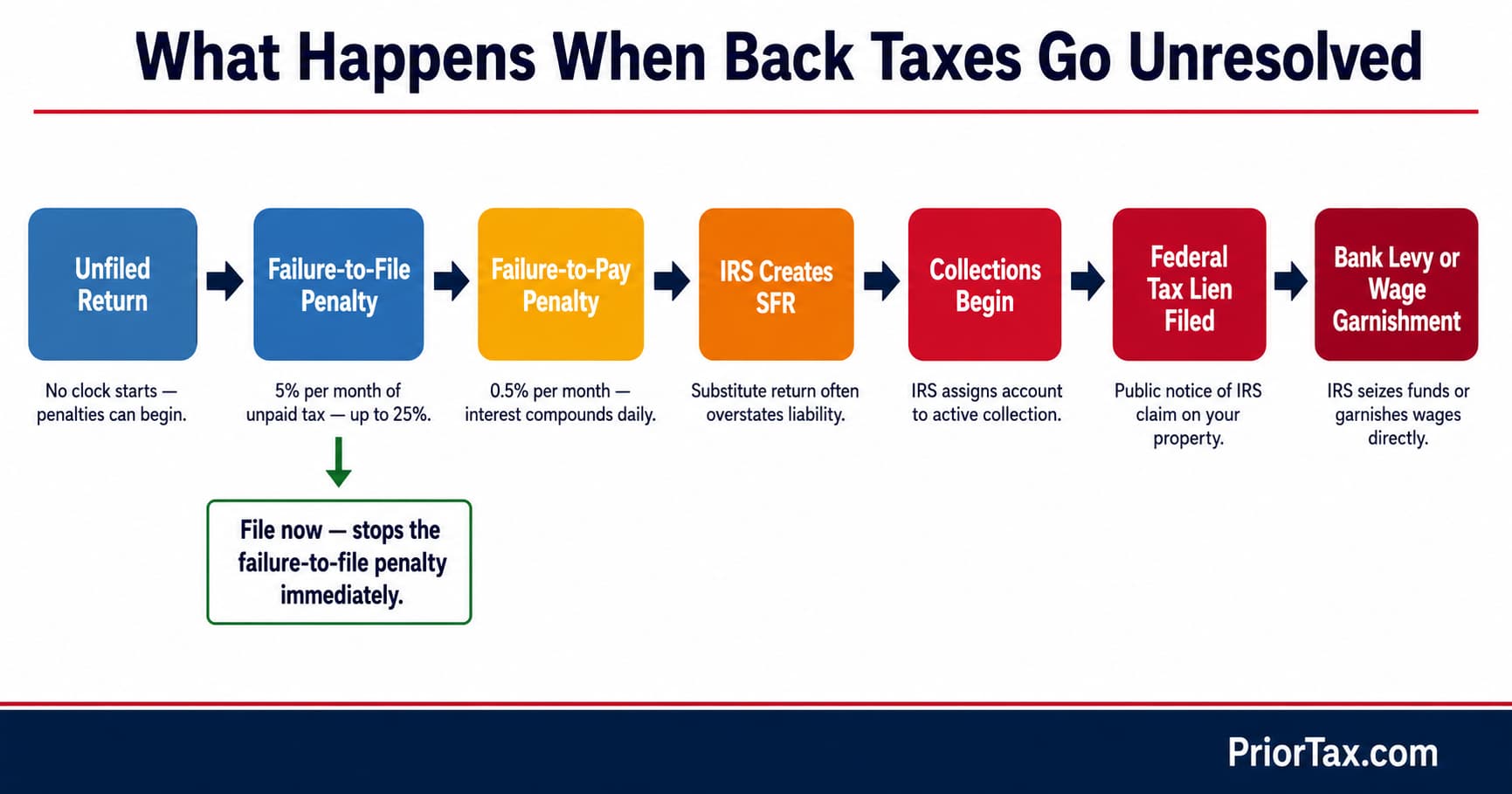
Filing stops the failure-to-file penalty from growing further, while the failure-to-pay penalty and interest may continue, so filing first usually cuts the total damage.
A partial payment still helps.
Any amount sent with the return reduces the principal balance, which lowers later interest charges and can soften the impact of future IRS bills.
Taxpayers often underestimate how quickly a nonfiled case escalates. If you want more detail on enforcement risk, this explanation of what happens if I don’t pay taxes shows why delay gets expensive.
Penalties and Interest: What Usually Grows and Why
Failure-to-file and failure-to-pay are separate charges.
IRS penalties can stack, and interest on unpaid taxes keeps accruing until the balance is resolved, which means old debt grows even when no new return is due.
Estimated tax payments also matter.
If withholding and estimates were too low in the original year, the final bill may include underpayment consequences in addition to the regular balance due, while Texas Comptroller penalties can follow different structures, including 5 percent and then 10 percent late-payment tiers for some taxes.
Step 4: Submit Returns Correctly and Track Processing
File each year separately and keep a full copy of each package.
That copy should include the return, schedules, W-2 or 1099 attachments when required, and proof of e-file acceptance or mailing, because older-year processing disputes often turn on documentation.
Paper returns for older years move slowly.
Processing can take months, so taxpayers expecting refunds or trying to stop collection activity should build in time and monitor transcripts after filing.
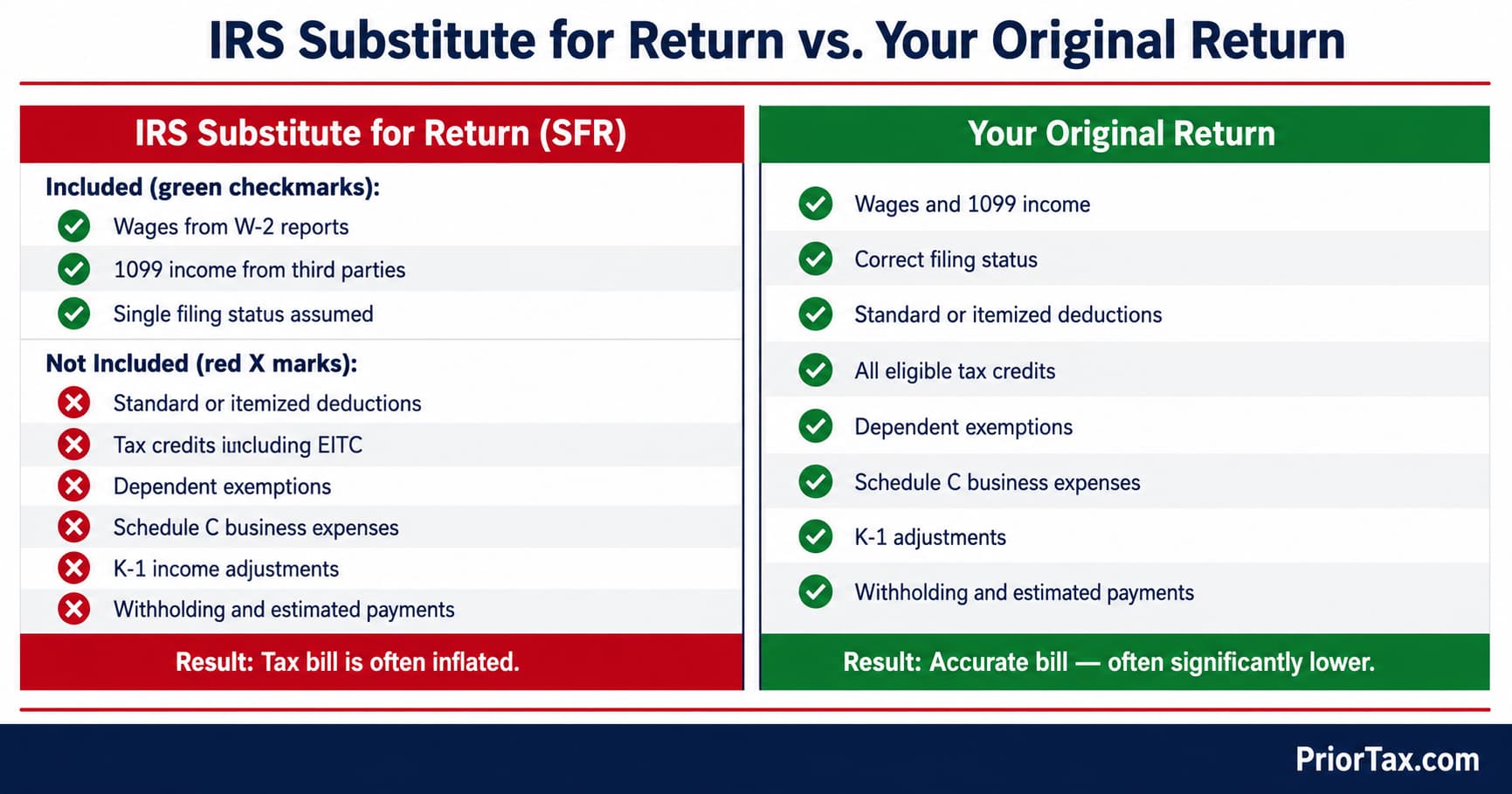
If the IRS Filed a Substitute for Return (SFR)
An IRS Substitute for Return usually overstates tax because it often ignores deductions, exemptions, and credits the taxpayer never claimed. Filing your own accurate original return can replace the SFR figures and reduce the assessed amount.
Match every income item to a tax transcript before sending the return. That step cuts mismatch letters and helps prevent the IRS from treating your filing as incomplete.
If You Owe After Filing: Practical Resolution Paths
Once the returns are filed, the debt becomes easier to manage because the IRS can evaluate real numbers instead of estimates.
Many taxpayers qualify for an installment agreement, while others need hardship-based options supported by financial records.
Ignoring notices invites collection action.
The IRS can file liens, issue levies, garnish wages, and seize bank funds, so a filed return is not the end of the case if the balance remains unpaid.
Common IRS Options After You File
An installment agreement spreads the balance into monthly payments. That route works best when the payment fits your budget well enough to avoid default.
An Offer in Compromise may settle for less than the full amount if the taxpayer can document limited ability to pay.
Currently Not Collectible status can pause active collection when basic living expenses leave no room for payments.
Penalty Relief You May Be Able to Request
Penalty abatement can reduce part of the bill if the facts support relief. First Time Abatement may apply when prior compliance history is clean, while reasonable cause requests depend on proof such as illness, disaster, or destroyed records.
Texas-Specific Situations to Watch
Texas business owners often focus on federal income tax and miss separate state filing duties.
A company with no federal income tax due may still owe sales tax reports or franchise tax filings, which means being “caught up” with the IRS does not always mean being current in Texas.
Property tax debt follows local collection rules set county by county, from Travis County in Austin to appraisal district for El Paso County on the border, and can result in a tax lien or foreclosure action separate from federal enforcement.
That split matters because paying the IRS will not stop county property tax collection.
Tax Filing and Child Support in Texas
Refunds can be intercepted for certain debts, including child support obligations.
The Texas Attorney General handles child support enforcement, so a child support offset can reduce or eliminate an expected federal refund before you receive it.
Free filing help may be available through VITA, and taxpayers expecting an offset should plan cash flow carefully. A refund that exists on paper may never arrive in your bank account.
Common Mistakes When Catching Up on Back Taxes
Wrong-year forms create avoidable rejections.
So does mixing documents from different years, especially when old W-2s and 1099s are incomplete and not checked against transcript data.
Many people wait because they cannot pay. That choice usually increases cost, and taxpayers who need help with prior tax years or guidance after if you missed a tax deadline should focus on filing accuracy first.
Quick Accuracy Checklist Before You Submit
Verify your name, Social Security number, address, filing status, dependents, and bank details if a refund is still possible.
Reconcile withholding, estimated payments, and prior IRS credits so the final balance is based on complete records rather than preventable errors.
FAQs
Can I still file old tax returns?
Yes. You can file old federal returns using the correct year’s forms, though older years may require paper filing. Refunds are usually available only within three years of the original due date.
How many years can you go without paying taxes in Texas?
Texas has no state personal income tax, but federal income tax still applies. If you owe the IRS, collection can continue for years, and the number of returns you must file depends on your record and IRS requirements.
Is SSDI taxable in Texas?
Texas does not tax personal income, so SSDI is not taxed by the state. Federal taxation of SSDI depends on your total income, filing status, and other taxable benefits.
How far back can you file taxes?
You can file many prior years, but refund claims usually expire after three years from the original filing deadline.
If you owe, filing sooner limits failure-to-file exposure and reduces the chance of enforced collection.
Does filing back taxes work differently in Houston, Dallas, or Austin?
The federal process is the same in every Texas city. You file prior-year Form 1040s with the IRS regardless of metro. What changes locally is property tax, which is handled by your county appraisal district: Harris County for Houston, Dallas Central for Dallas, Travis Central for Austin, Bexar for San Antonio, and Tarrant for Fort Worth. Federal back taxes and county property tax are separate problems, and being current with one does not resolve the other.
Old tax problems in Texas usually become manageable once you separate federal, state business, and local tax issues.
The strongest move is usually the least dramatic one: identify the missing years, use the right records and forms, file each return correctly, and deal with payment options after the paperwork is current.

About The Author
Willem Veldhuyzen is the founder and president of PriorTax. PriorTax has been in business for 20 years since 2006, and he’s hands-on with tax calculations, software updates, and customer support.

Categories: